
Swisher County Release Records
A Swisher County release means that one custodian ended a custody episode. It does not always mean the person entered the community. The Swisher County Sheriff keeps the county jail booking and release event. TDCJ keeps state-prison movement, parole, mandatory-supervision, and discharge information. A court order explains the legal basis, but the order may precede the time the jail completes release processing.
Common outcomes include bond, a personal recognizance release, dismissal, time served, sentence completion, probation, transfer, parole, mandatory supervision, and flat discharge. Bond permits pretrial release while the case continues. Probation, also called community supervision, is imposed by a court. Parole and mandatory supervision allow a state prisoner to serve part of a sentence in the community under TDCJ supervision. Flat discharge means the TDCJ sentence has ended.
| Release label | What it means | Best confirmation |
|---|---|---|
| Bond or recognizance | County custody ends while the case continues | Sheriff event plus bond order |
| Time served or sentence complete | A local custody term ends, unless another hold applies | Release event and judgment |
| Transfer | Custody continues with another agency | Sending and receiving agency records |
| Parole or mandatory supervision | State custody changes to supervised community release | TDCJ status and release history |
| Flat discharge | The state sentence ends | TDCJ discharge date |
A dismissal does not state the moment of physical departure. Likewise, an ICE or federal pickup is a handoff, not a community release. The receiving agency must be checked before describing the outcome.
Swisher Release Record Fields
A useful request identifies both the person and one custody episode. Ask for existing fields rather than asking staff to write a summary. The county jail register is especially important because Texas retention rules make it permanent, even though Swisher County has no public online archive.
| Field | What it shows |
|---|---|
| Full name, aliases, booking number | Which person and jail episode the record concerns |
| Booking date and time | When county custody began |
| Release date and time | When that custody episode ended |
| Release authority and reason | Bond, court order, sentence completion, or another basis |
| Charge and bond | The booked allegation and any release security |
| Destination or receiving agency | Community release versus continued custody |
| Booking photograph | The image tied to that booking, if lawfully released |
A name alone can match more than one person. Include an approximate booking range, case number, booking number, or date of birth only when needed to separate matches. Ask for the event, custody, bond, transport, and transfer records if those are stored separately.
- Discharge
- The end of a sentence or supervision term.
- Detainer
- A request or hold from another authority that may delay community release.
- Expunction
- A court-ordered process that can remove qualifying records from public access.
- Nondisclosure
- A court order that restricts public access to qualifying Texas records.
Request Swisher Release Records
The sheriff does not publish a dedicated request portal, fee list, or records hours. Call 806-995-3326 to confirm delivery, then send a narrow written request to the Swisher County Sheriff's Office, 136 East Broadway, Tulia, TX 79088, or email so@swisher-tx.org. Texas Government Code Chapter 552 governs administrative public records. It does not require an office to create a new report.
- Identify the full name, date range, and booking or case number if known.
- Ask for the existing booking and release or transfer records.
- List the specific date, time, authority, reason, bond, destination, and image fields sought.
- Request electronic copies when available and ask for a cost estimate.
- If a field is withheld, request the cited exception and any separable public portion.
The ten-business-day provisions in the Public Information Act often concern agency notices and Attorney General procedures. They are not a promise that every record arrives within ten days. Charges depend on the responsive material and official cost rules.
Swisher Court Records Preserve Context
Swisher County has one elected County and District Clerk serving both misdemeanor and felony record routes. That combined office is a strong long-term source after a person falls off custody systems. The clerk's iDocket instructions cover criminal indexes and case information from January 1, 1992 forward. Judicial records are not handled under the sheriff's Public Information Act process.
The Swisher clerk record-request page provides the proper judicial-record procedure. Search by name, identify the case number, then ask for a docket sheet, bond order, dismissal, judgment, sentence, commitment, jail-credit notation, community-supervision order, or revocation filing. The clerk says requests are reviewed and answered with availability and cost information within ten business days.
The screenshot below comes from the official clerk request page and shows the local iDocket and request route.
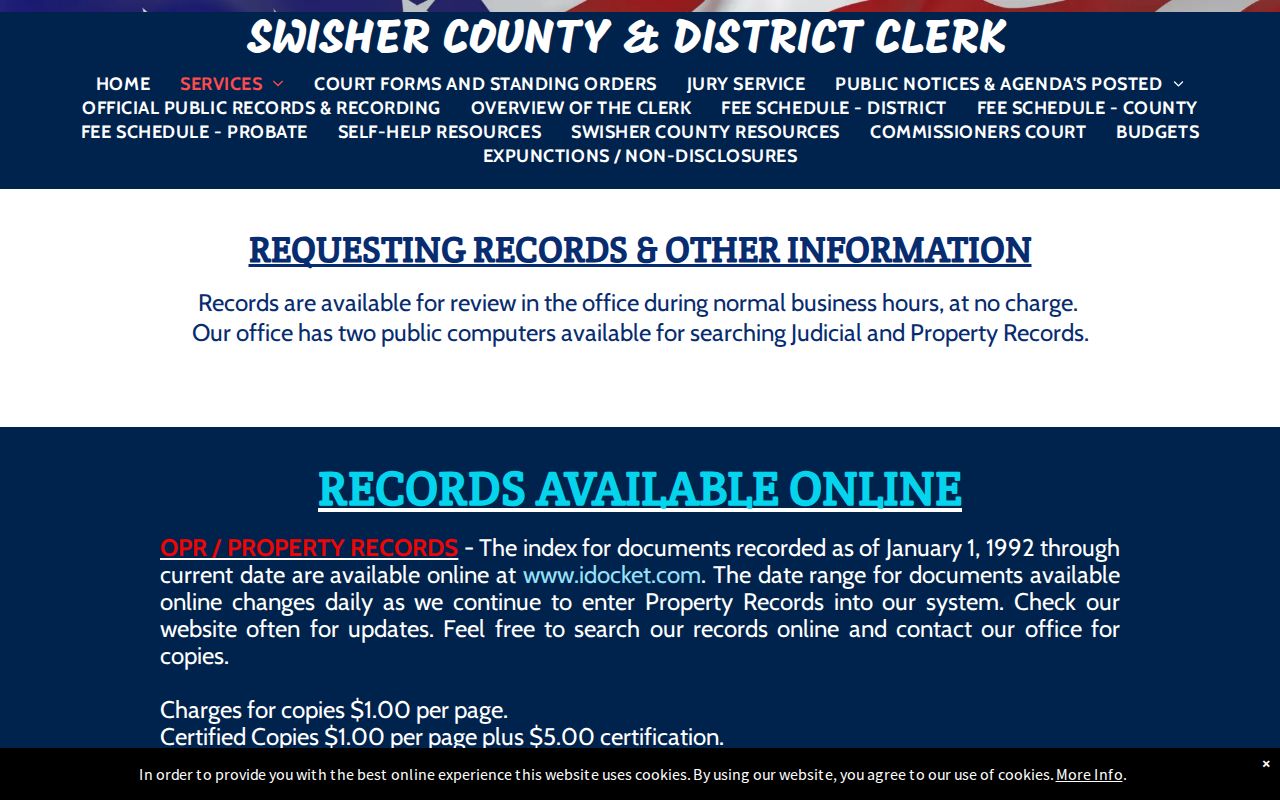
The clerk record can explain why custody changed. Pair it with the sheriff event to establish when physical custody actually ended.
Swisher Release Records and Sealing
Texas expunction law appears in Code of Criminal Procedure Chapter 55A. Nondisclosure is governed by Government Code Chapter 411. Eligibility is case-specific, and release alone does not qualify a record. Juvenile, sealed, expunged, and nondisclosed information may be withheld from public access.
A missing online result is not proof that no custody event occurred. It can reflect an old record, a name mismatch, a system limit, or a lawful access restriction. Do not try to bypass a court order. Use the issuing court or records custodian when a correction or access question arises.
Can a court disposition prove release? It can prove the case outcome or authority. It usually cannot prove the exact door time, so the sheriff or TDCJ event remains essential.
Find Swisher County Released Inmates
Start with the last known custodian. This avoids treating a county, state, federal, or immigration result as interchangeable. Current services help orient the search, but a blank result does not establish release.
- For Swisher County Jail, check IVSS-Counties, then call the sheriff and ask about release versus transfer.
- For Mechler or another state unit, search TDCJ by number or SID when possible.
- Request the historic release or discharge event from the office that held the person.
- Use the Swisher clerk case record to confirm the legal basis.
- Check parole, probation, federal supervised release, or immigration duties when relevant.
- Resolve conflicts with the releasing or receiving agency.
Swisher County does not publish an official 24-hour or 72-hour release feed. A named-person search should use direct custody and records channels, while the Jail Releases: 24 Hours page explains the same-day fallback.
TDCJ Swisher Release Search
The TDCJ Inmate Search is correct for a person sentenced to state prison, including someone housed at Mechler. It is not the archive for a county-only jail stay. Search with a TDCJ number or SID when known. If searching by name, compare the conviction county, age, offense, and identifying number before accepting a match.
| Search field | Use | Limit |
|---|---|---|
| TDCJ number | Strong state identifier | Seven-digit number may be unknown |
| SID | Texas state identifier | Must match the correct person |
| First and last name | Broad discovery | Name collisions are common |
| Demographic filters | Narrow a name search | Do not replace identifier checks |
| Projected Release Date | Shows an administrative projection | Can change and is not actual release |
The official search interface below shows the fields used for a Swisher County state release lookup.
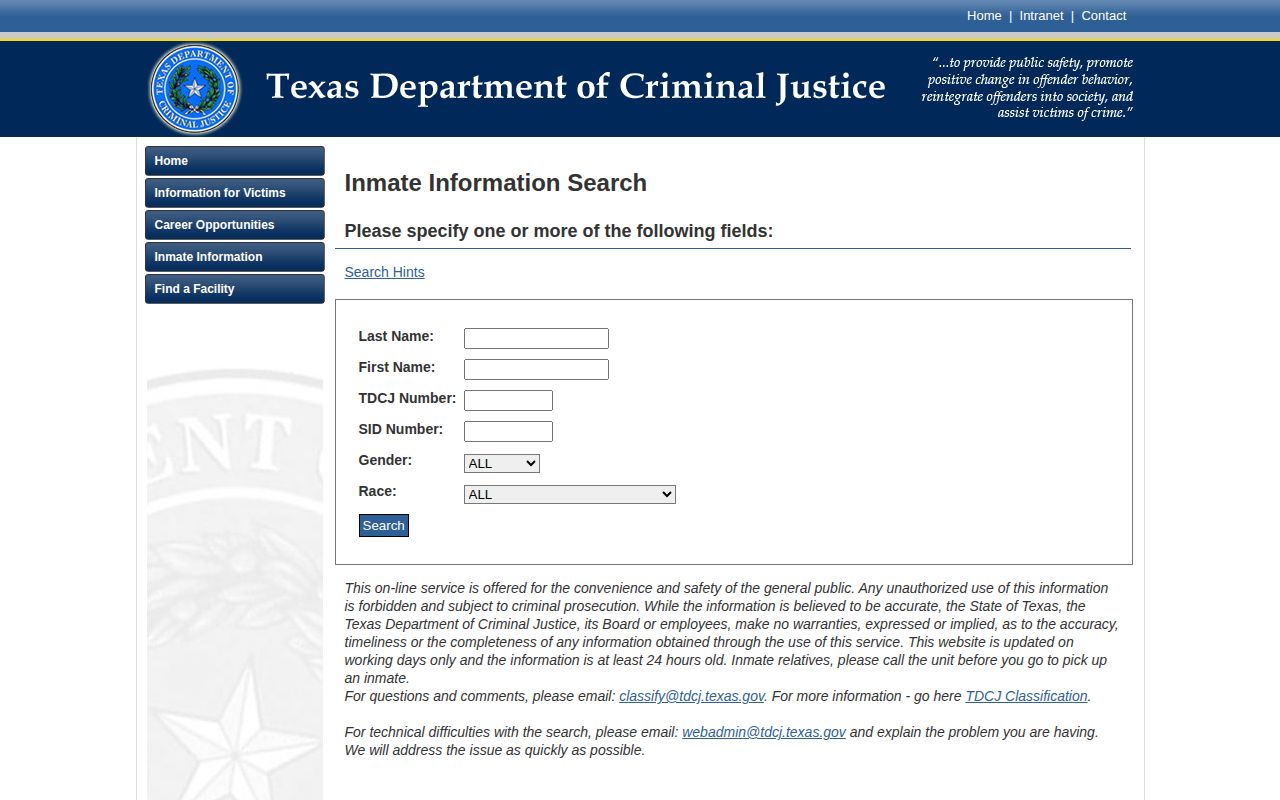
If no older result appears, use the TDCJ no-charge email route or a formal public-information request for incarceration and discharge history. Ask for release type, discharge date, maximum expiration, and parole or mandatory-supervision status.
No Swisher Recent Release Feed
As reviewed August 2, 2026, the official sheriff page had no roster, booking log, recent-release list, mobile lookup app, or booking-photo gallery. It linked to the former Texas VINE service. The current county notification system is IVSS-Counties, which can show participating custody information and send status alerts.
IVSS is a notification service, not the official historical record. A person can disappear after release, data can lag, and a failed match proves nothing. Call the jail and ask for the actual release or transfer time. If the answer is transfer, continue with the named agency.
The official sheriff screen documents the local contact path and the absence of a release archive.
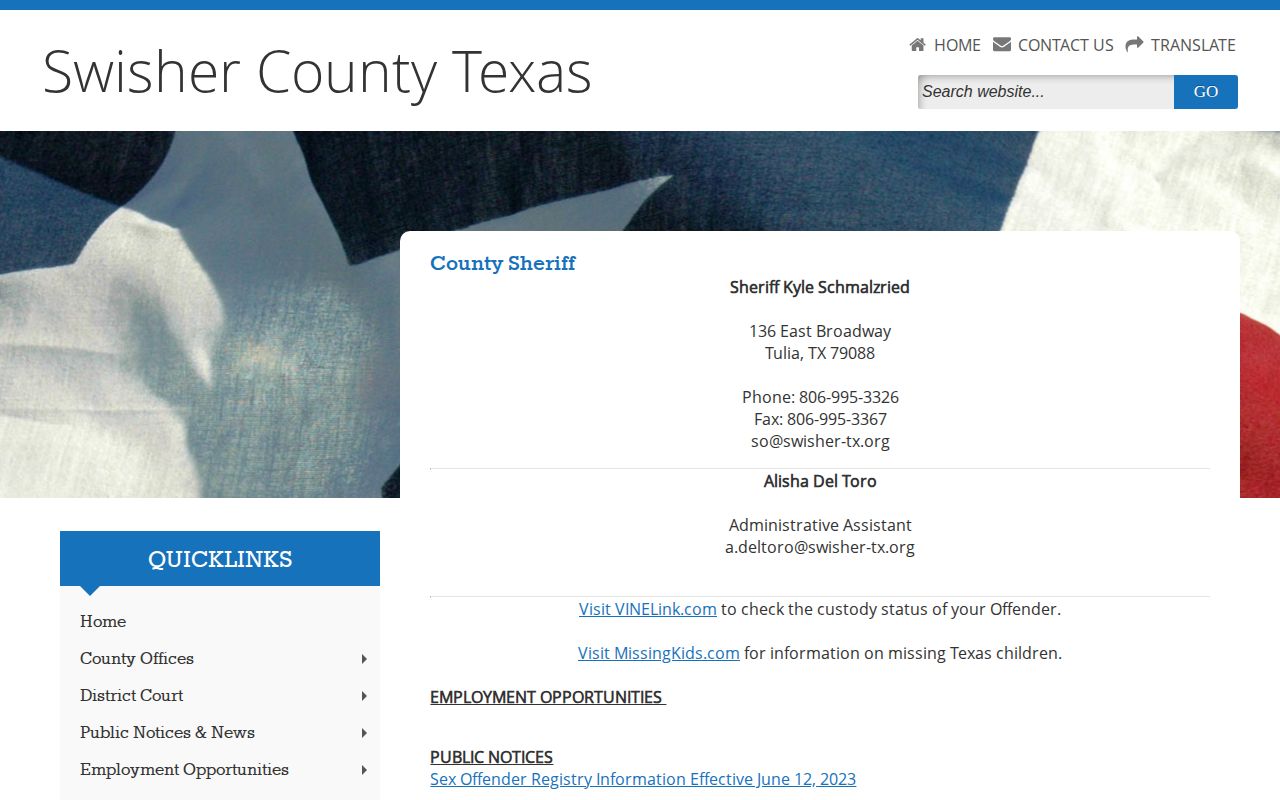
That sparse gateway makes the permanent jail register and a focused records request central to Swisher County release research.
Swisher County Facility Difference
Facility identity is the first local question. A 2022 Texas Commission on Jail Standards snapshot listed the county jail at 27 beds. TDCJ lists the Thomas R. Mechler Unit at 606 capacity. These figures come from different systems and dates, but their contrast helps explain why a vague reference to a “Tulia jail” can send a search down the wrong path.
Swisher County Jail is run by the sheriff and may release a person on bond, court order, or sentence completion. Mechler is a TDCJ prison and transfer unit. A movement out of either building may still be a transfer, but confirmation comes from different record custodians.
Mechler Transient Release Status
TDCJ classifies Mechler as a low-custody and transient unit. “Transient” means some prisoners are there as part of movement through the state system. A person who no longer appears at Mechler may be at another TDCJ unit and still fully incarcerated. Search the statewide record for the current location and read the release type literally.
Actual state release may be parole, mandatory supervision, discretionary mandatory supervision, or flat discharge. Parole and mandatory supervision retain supervision in the community. Flat discharge ends the sentence. The Thomas R. Mechler Unit release page keeps those state pathways separate from county jail records.
Does leaving Mechler prove release? No. A unit transfer is continued TDCJ custody. Confirm a community release through TDCJ offender information, Review and Release Processing, or a discharge record.
Mechler Pre-Release Program Meaning
Mechler's official program list includes CHANGES/Pre-Release. That fact shows TDCJ offers pre-release preparation at the unit. It does not prove that a named person enrolled, completed the program, received Board approval, or left custody.
Program status and custody status answer different questions. Use TDCJ records for the actual event, then check the Plainview District Parole Office if the result shows parole or mandatory supervision. County probation remains a separate court system.
When Mechler Releases Occur
TDCJ publishes state release logistics that can apply to a Mechler release. Most scheduled releases occur from the assigned or designated releasing site during weekday business hours, excluding holidays. Final audits, warrants, detainers, program completion, and release-plan approval can change the site, date, or time.
Those are TDCJ procedures. Swisher County has published no matching county-jail release schedule. Never apply the state window to the sheriff's jail. Before traveling, contact TDCJ Review and Release Processing at 512-406-5202 and verify the assigned site and current plan.
Note: A projected state date supports planning, but only the completed TDCJ event confirms that physical custody ended.
Getting Home After Mechler Release
For eligible TDCJ releases, family may pick up the person at the designated site. TDCJ can also provide a bus ticket toward the station nearest the approved residence. This is a state-prison arrangement and not a transportation promise from Swisher County Jail.
Call before travel because the designated site can move. An approved release may still await final processing. The person may also leave under supervision, so the approved residence and reporting terms matter even after prison custody ends.
Federal Swisher Release Checks
No federal prison or ICE detention center was verified in Swisher County. A federal defendant may be held elsewhere through the U.S. Marshals Service. For a sentenced federal person, use the BOP Inmate Locator. It covers records from 1982 forward and can show a release date and “Released” or “Not in BOP Custody” status.
The official BOP interface below is the federal source assigned to this release path.
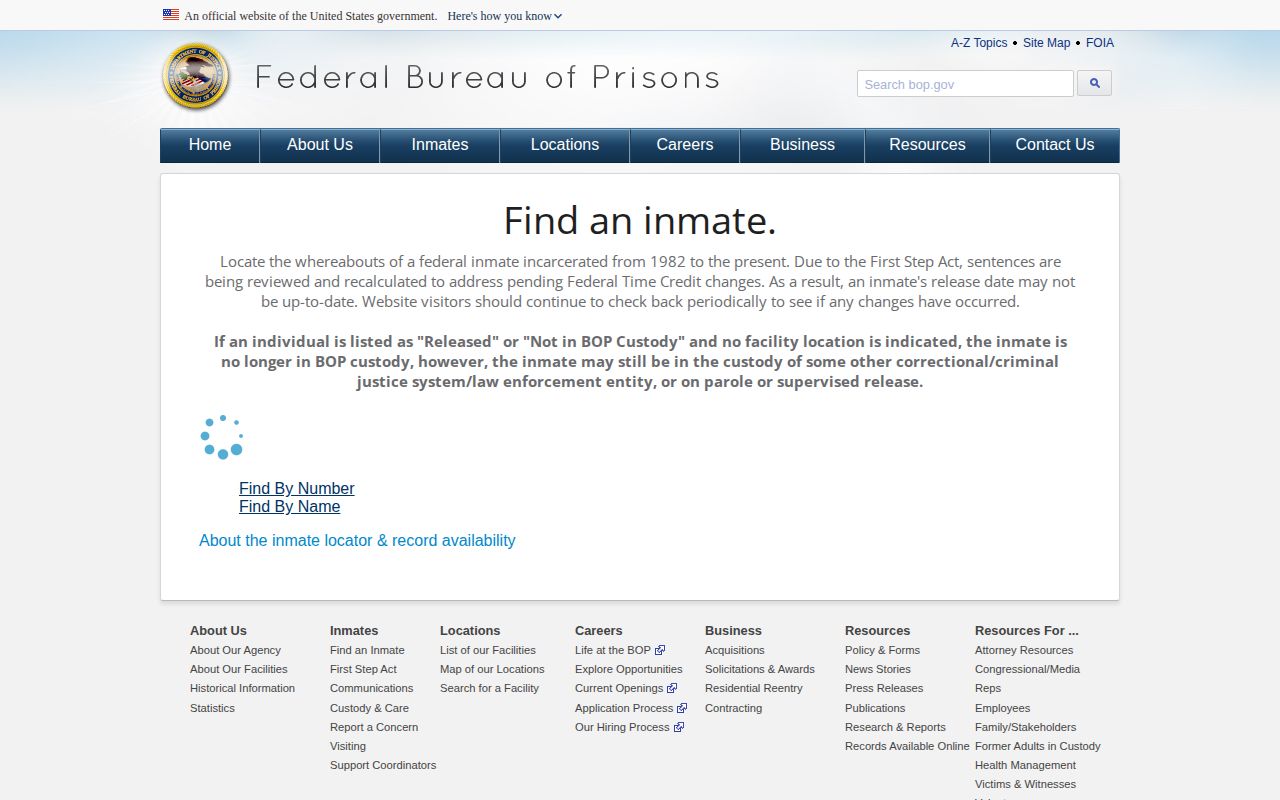
BOP release does not rule out supervision, local custody, state custody, or immigration custody. ICE's locator may include people released from ICE custody during the prior 60 days, but an exact no-result does not prove release.
Swisher County Detention Facilities
Only two detention facilities were verified in Swisher County. Choose the operator before choosing a search system.
| Facility | Operator and release trail |
|---|---|
| Swisher County Jail | Sheriff booking and release event, IVSS orientation, and local court record |
| Thomas R. Mechler Unit | TDCJ statewide offender search, release processing, and discharge records |
No separate Tulia municipal jail, BOP prison, or ICE detention center was found. Ask the arresting agency where a city arrest was booked before searching.
Swisher Release Search Cross-Checks
Conflicting results should be resolved in a set order. Confirm that each screen concerns the same person and custody episode, then compare event dates, booking or offender numbers, and the named custodian. A court order may precede release processing, while a notification can arrive after an agency sends its update. Neither gap should be filled with a guess.
Call the office that created the disputed event. Ask the jail for booking-out or transfer data, TDCJ for incarceration and discharge history, BOP for the federal record, or ICE for its limited custody information. The custody record shows what the custodian did. The court file shows authority. A supervision record shows duties after release. Together they distinguish release, discharge, transfer, and continuing supervision.