
Swisher VINELink Became IVSS
Texas moved county victim notification from VINE and VINELink to IVSS-Counties on September 1, 2025. The Swisher County Sheriff’s page still sends visitors toward an old Texas VINE site ID. That stale link confirms historic county participation, but it is not the right registration instruction for 2026.
The Texas Attorney General transition notice says existing VINE registrations carried over. Returning account holders may need to update a password. Current users should follow the controls shown by IVSS-Counties because labels and verification steps can change. Help is available at 866-268-8959 around the clock.
Search Swisher County IVSS
Begin with the facility. A county detainee belongs in IVSS-Counties. A person held at Thomas R. Mechler Unit is in TDCJ, even though the unit is near Tulia. Searching the wrong portal can create a false no-result.
- Open IVSS-Counties and search by full or partial name, DOC ID, SID, Jail ID, or permanent booking number.
- Prefer a known identifier. If only a name is available, compare all displayed details before choosing a record.
- Open the matching entry and read the custodian and status literally.
- Do not treat absence as release. The portal may stop showing a person after county custody ends.
- Call the Swisher County Jail at 806-995-3326 for the actual booking-out or transfer event.
The portal is a notification and orientation service. It expressly is not the official record. For durable proof, request the sheriff’s booking and release or transfer fields.
Swisher IVSS Status Fields
IVSS searches and alerts serve a narrower role than a jail register or court file. They help identify a current custodian and flag certain changes. Read each field in its own context.
| Item | How to use it |
|---|---|
| Name and identifiers | Compare the person before relying on the result |
| Custodian or facility | Distinguish Swisher jail from TDCJ or another agency |
| Custody or supervision status | Read the exact label without inferring an outcome |
| Release alert | Shows the system received a release event |
| Transfer alert | Signals continued custody under another location or agency |
Other qualifying notices can include escape, death, and court changes. None should be paraphrased as ordinary release. Save the date, time, source, and wording of an alert before seeking confirmation.
Register Swisher Release Alerts
Registration begins only after a matching record is found. IVSS-Counties permits a notification request with or without an account. Available delivery choices and button labels should be taken from the live interface.
- Open the verified matching record.
- Select the available notification option.
- Choose a contact method offered by the current portal.
- Enter the requested contact details and complete its verification or confirmation.
- When an alert arrives, note whether it says release, transfer, or another event, then contact the custodian.
A release alert proves that the service received a status event. It does not by itself prove destination, case outcome, or the end of all supervision. A transfer alert means the person stayed in custody. Duplicate names, changed identifiers, agency corrections, and feed delay are further reasons to confirm.
Legacy Swisher PIN Instructions
Old Texas VINE brochures told telephone users to create a PIN and enter it to acknowledge an automated call. The service could retry calls when an alert was not acknowledged. Those directions help explain an old screenshot or a past registration, but they must not be used as a current sign-up path.
Texas replaced that county workflow in 2025. Existing registrations reportedly carried forward, while the current interface controls password and contact verification. Any old brochure or PIN reference should be labeled as legacy material replaced on September 1, 2025.
Search Swisher TDCJ Notifications
State prison and parole events use the separate TDCJ IVSS portal. This is the correct notification layer for Thomas R. Mechler Unit and other TDCJ facilities. It can support notices involving prison release, discharge, supervision, warrants, and parole processes. TDCJ Victim Services also provides a notification request route, 800-848-4284, and victim.svc@tdcj.texas.gov.
Mechler is officially a transient unit. A person can leave it through an internal TDCJ transfer without entering the community. Compare the notification with the TDCJ offender search, then confirm whether the event was parole, mandatory supervision, flat discharge, or a move to another unit.
The official TDCJ IVSS interface shows the distinct state-system route.
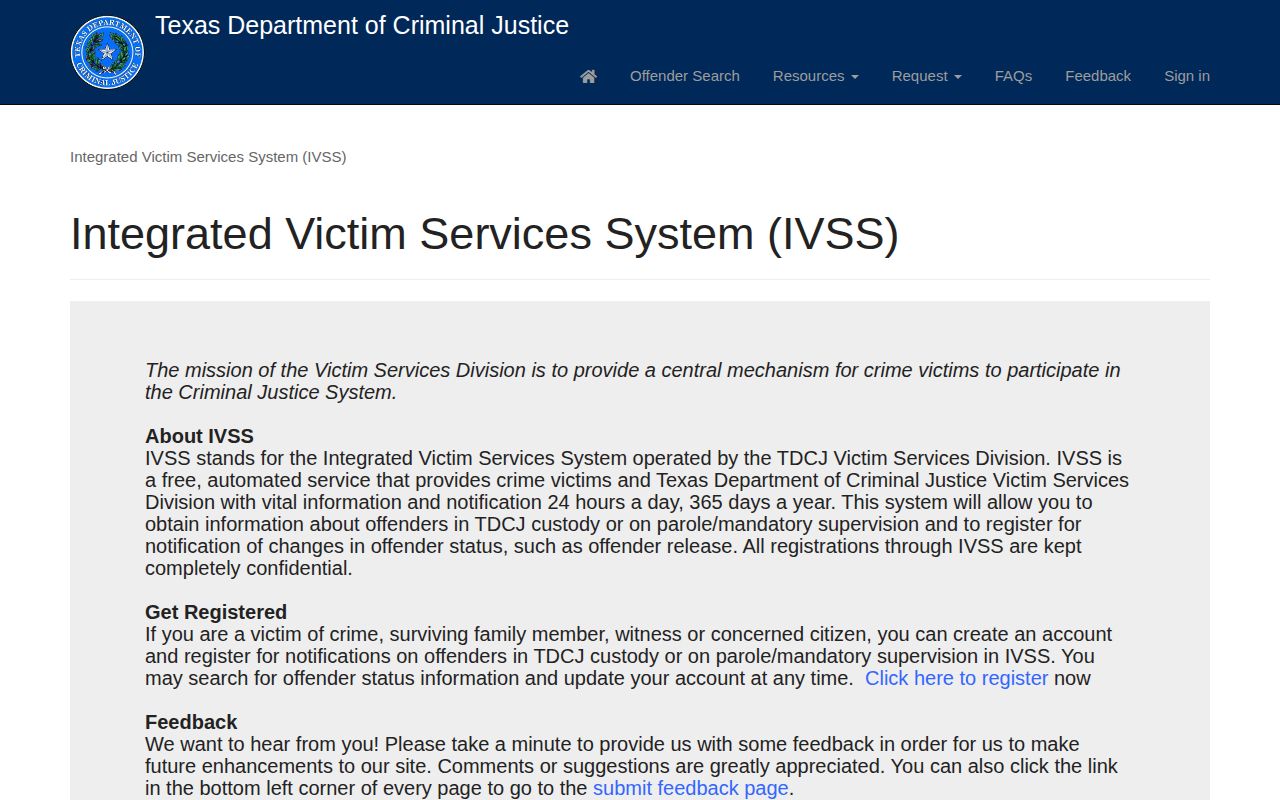
This screen should be used for state prison and parole records, not for a county-only booking at Swisher County Jail.
Confirm Swisher IVSS Alerts
County release confirmation comes from the Swisher County Sheriff at 136 East Broadway, Tulia, TX 79088, 806-995-3326, or so@swisher-tx.org. Ask for the actual release or transfer time, authority, reason, and receiving agency. A narrow written request creates a more durable answer than a phone status check.
State release confirmation comes from TDCJ offender information, Review and Release Processing, or a formal TDCJ record request. Federal custody is outside both Texas IVSS portals. Use the BOP Inmate Locator for federal post-sentence custody and release information. ICE has its own detainee locator. A no-result in any one system is not proof of release.
- Notification
- A near-term message that a system received a defined event.
- Release
- An agency-recorded end to that custody event; supervision may still follow.
- Transfer
- Movement to another facility or agency while custody continues.
- Discharge
- The end of the sentence or supervision obligation identified by the responsible agency.
View Swisher County IVSS
The current IVSS-Counties search interface is the relevant visual source for a Swisher County jail check.
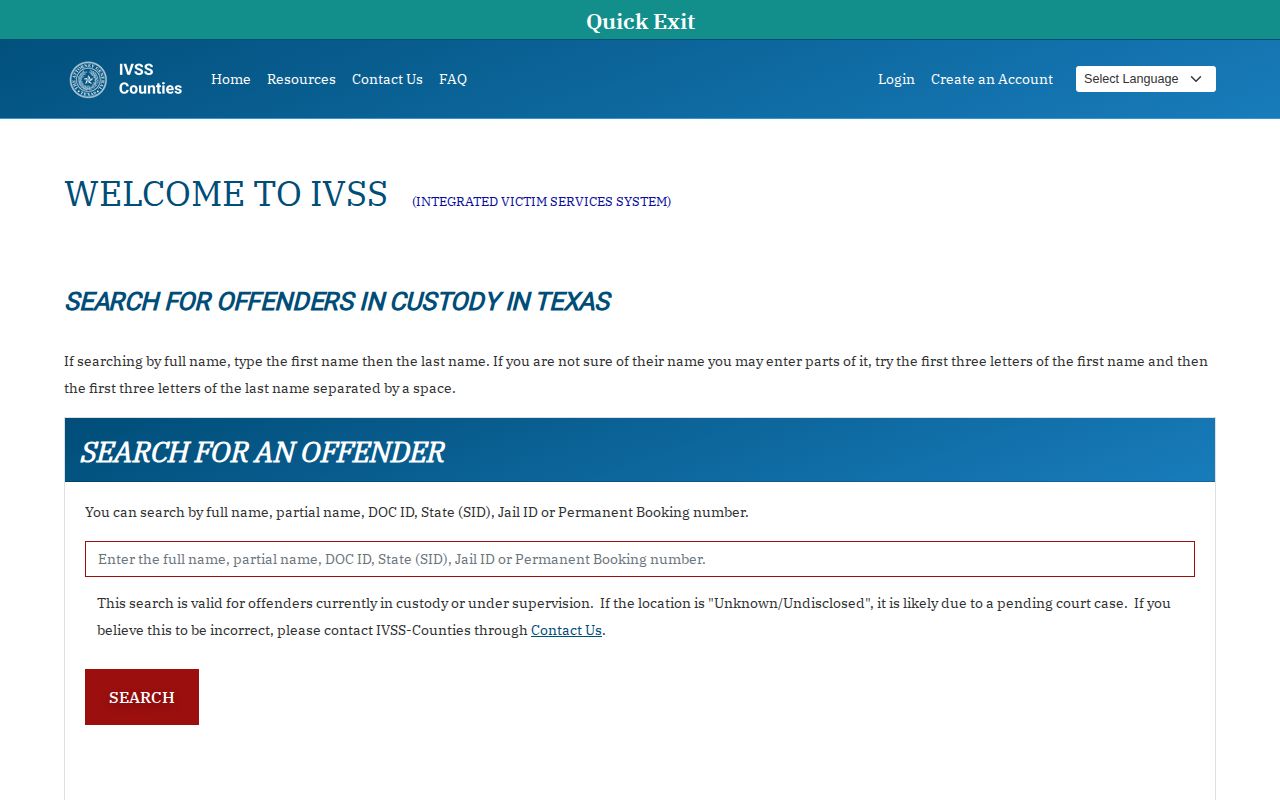
It supports a person-specific search and notification request, not a historic list of all released people. The official sheriff page documents the local contact path that should follow an alert. For broader records-based routes, use the Swisher County released inmate search.
Resolve Swisher IVSS No-Results
A blank search has several possible causes. The person may have left custody, moved to another agency, been entered under a different name, or never belonged in the selected portal. Search a known ID when possible and check spelling variants. Then identify the last confirmed custodian before moving to another system.
For Swisher County Jail, call the sheriff and request the booking-out or transfer event. If the record names TDCJ, follow the TDCJ number in the state offender search and state IVSS. If it names a federal or immigration custodian, use that agency’s locator. Court records can supply case context, but a judgment or bond order is not a custody timestamp.
Keep the systems separate. County IVSS supports county custody notices. TDCJ IVSS supports prison, parole, and mandatory-supervision events. BOP and ICE remain outside both. A sound search follows the person from one identified custodian to the next instead of treating a no-result as final.
Preserve Swisher Release Confirmation
Save the exact event label, date, time, identifier, and custodian shown by the notification. Do not retain more personal data than the permitted purpose needs. Next, request the official agency record that states the actual release or transfer time and reason.
For county records, give the sheriff a full name, date of birth if known, booking number, and narrow date range. Ask for existing booking and release fields rather than a custom narrative. For TDCJ, use offender information or a formal public-information request with the TDCJ or SID number. An official correction should replace an older alert.
This two-source method separates speed from proof. IVSS can flag a change quickly. The custodian’s record documents what occurred. If the alert says transfer, continue with the receiving agency. If it says release, check whether parole, mandatory supervision, probation, or another court condition remains.
Match Swisher Alerts to Records
An alert is a starting signal. Match it to the person, custody episode, and agency record before relying on the change. Write down the displayed identifier, custodian, exact event label, and event time. If a name has multiple matches, use the booking number, SID, TDCJ number, or Jail ID rather than age or spelling alone.
For a county event, ask the Swisher sheriff for existing booking and release or transfer fields. Request the actual time, authority, reason, bond information, and receiving agency. For a TDCJ event, compare the state offender detail and obtain a formal record when historic discharge or supervision facts are needed. Each agency should correct its own record if the sources conflict.
Court papers can explain the legal basis but not always the moment a person left. A release alert can also precede the arrival of a document copy. Keep the source and access date with each item. When a later official correction arrives, replace the older inference. This preserves a clear line between fast notification, current status, and durable proof of release.