
Swisher County Projected vs Actual Release
A projected date is a calculation based on the sentence and information available when the agency updates the record. TDCJ defines its Projected Release Date as the date determined by the sentence and applicable time credits, with different treatment depending on whether the person is eligible for parole or mandatory supervision. A Scheduled Release Date can reflect an approved release moving through final processing. The actual release date records the event after the person leaves that custodian.
A pretrial detainee usually has no sentence-based release date. Release turns on bond, a court order, dismissal, transfer, or final disposition. Asking the jail to compute a prison-style projected date for that person uses the wrong framework. A county-sentenced person may have a calculation maintained by the sheriff, while a state prisoner has TDCJ dates.
Find a Swisher County Projected Release Date
Begin with custody classification. Swisher County Jail and Thomas R. Mechler Unit are different systems even though both are associated with Tulia. The jail is operated locally; Mechler is a TDCJ unit and includes transient custody. A move away from either facility can be a transfer rather than community release.
- Confirm the person's full name, date of birth, booking identifier, SID number, or TDCJ number.
- For Swisher County Jail, call 806-995-3326 and ask whether the person is pretrial, county-sentenced, transferred, or released. For a sentence calculation, ask which existing record contains the jail's current date.
- For state custody, search the TDCJ offender database by TDCJ number, SID number, or name and birth details.
- Read the location, Projected Release Date, Maximum Sentence Date, parole eligibility, and parole status together. Do not isolate one field.
- If an entry is unclear or a historical date is needed, use the TDCJ no-charge offender-information request with the person's identifiers.
- After the expected date, confirm actual release through the custodian and request the release record if repeatable evidence is needed.
The Swisher County released-inmate guide explains how court disposition, jail release, and TDCJ status fit together after the person is no longer on a current-custody screen.
Swisher County TDCJ Release Fields
The TDCJ result page can carry several dates that answer different questions. The Maximum Sentence Date reflects the sentence endpoint as calculated by the agency. Parole Eligibility Date concerns when review may occur, not when release must occur. Projected Release Date is a working release calculation. A parole status or Board decision may add context without proving physical departure.
The official TDCJ information page explains the Projected Release Date field and how to request offender information. Its captured view appears below. Use the live page for current instructions because agency forms and labels can change.
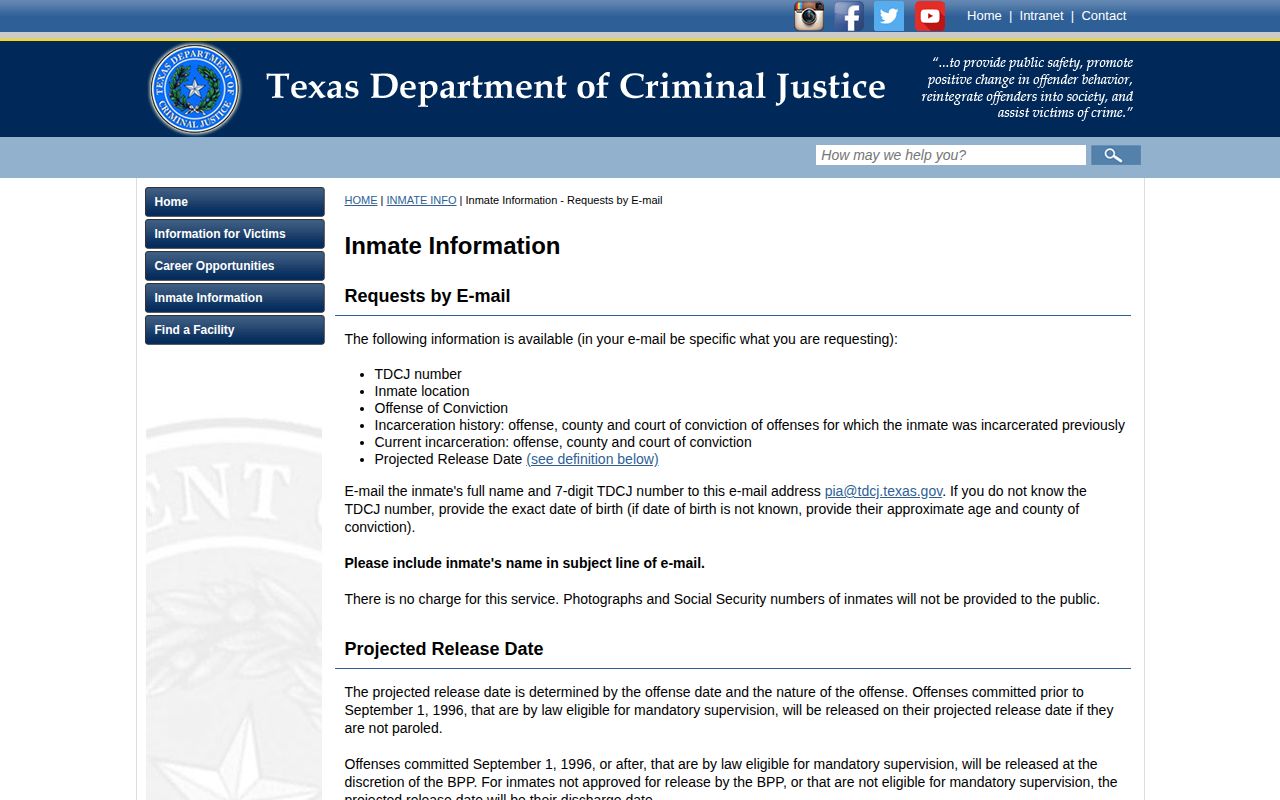
Search results should be matched carefully. Name-only searching can return multiple people, and the county of conviction may not be the present facility county. Swisher County can be relevant because of conviction, jail custody, supervision, or the Mechler Unit, so verify which connection the record actually shows.
Swisher County Jail Time Credit
Texas Code of Criminal Procedure Article 42.032 permits a county sheriff to grant commutation not exceeding one day for each day actually served for good conduct, industry, and obedience. The statute uses “may.” It does not prove that Swisher County awards the maximum credit to every eligible person. Misconduct and forfeiture rules can also affect a calculation.
For a county sentence, request the existing calculation or release order from the sheriff and pair it with the judgment from the Swisher County and District Clerk. Do not estimate a date by simply dividing the sentence. Credit for time already served, the judgment's terms, later court orders, holds, and the sheriff's authorized calculation all matter.
TDCJ good-conduct time under Government Code Chapter 498 is a separate state-prison system. It can affect eligibility calculations but does not shorten the judicial sentence itself. Texas also has offense-specific parole and mandatory-supervision rules in Government Code Chapters 508 and related statutes. There is no accurate blanket statement that every Texas prisoner must serve exactly 85 percent of a sentence.
Why Swisher County Release Dates Change
A changed date does not automatically signal a mistake. It may reflect a lawful update to one of several inputs. Compare the new entry with the court, jail, or TDCJ source that controls it.
| Factor | Possible effect | Best confirmation |
|---|---|---|
| Credit calculation | Earned credit, forfeiture, or corrected time served changes the working date | Sheriff calculation or TDCJ time records |
| Court action | Amended judgment, appeal, new sentence, or release order changes authority | Signed court document |
| Parole review | Approval, denial, next review, or required program affects release planning | Board result and TDCJ status |
| Detainer or hold | Another agency may assume custody even when the first custodian releases | Releasing and receiving agencies |
| Transfer | A facility location changes without release from custody | Current statewide or receiving-system record |
| Final audit and logistics | Record checks, approved plan, program completion, or release-site arrangements delay departure | TDCJ Review and Release Processing |
A parole approval can contain a future-release code and conditions. “Approved” is therefore not equivalent to “released.” Program completion, an acceptable plan, detainer resolution, and final processing may remain outstanding.
Mechler Unit Release or Transfer?
Thomas R. Mechler Unit is a TDCJ facility at 4000 Highway 86 West, one mile west of Tulia. TDCJ identifies it as a male G1/G2 and transient unit. Transient classification makes the location field especially important: disappearance from Mechler can mean reassignment inside the prison system.
Search the statewide TDCJ record for a new unit, Projected Release information, and a release type such as parole, mandatory supervision, or discharge. A county jail record cannot verify departure from TDCJ. Conversely, TDCJ's search is not the correct place for a person whose only custody was at Swisher County Jail. The Mechler Unit guide separates those paths.
Swisher County Parole Date Limits
Parole eligibility is the point at which a case may be considered under applicable law. It is not a guaranteed release date. The Board of Pardons and Paroles conducts ordinary review through an individual file-voting process rather than a public hearing calendar. A denial may establish a later review date; an approval may carry a future-release or program-related code.
Government Code Section 508.145 contains eligibility provisions, and Section 508.149 lists mandatory-supervision exclusions. Offense, sentence, time credits, institutional record, Board action, and release-plan processing can interact. For person-specific status, use TDCJ offender information and the Board's parole status line, 844-512-0461. The Probation & Parole guide identifies the Plainview office that supervises verified Swisher County state releases after custody ends.
Confirm Swisher County Actual Release
Check again after the expected date. For a county case, ask Swisher County Jail whether the event was release to the community or transfer and request the actual release or transfer date, time, reason, authority, and destination when releasable. The sheriff lists 136 East Broadway, Tulia, TX 79088, 806-995-3326, and so@swisher-tx.org. No fixed release hours or production timetable is published, so call before relying on a visit or request method.
For TDCJ, confirm status through the offender search or the information request. Review and Release Processing at 512-406-5202 can address approved or scheduled state-release arrangements. Most scheduled TDCJ releases occur during weekday business windows excluding holidays, but the final date and site must be verified. That statewide practice must not be presented as Swisher County Jail policy.
The current county-notification system can supply a status alert, but an alert is not the official record and may not identify destination. See VINELink Inmate Search for the present IVSS-Counties route. Preserve the alert time, then verify the event with the jail or TDCJ. If another agency takes custody, follow the receiving system rather than describing the event as freedom in the community.
Older dates may require a written request because a present-tense locator is not a complete discharge archive. For the sheriff, identify the booking episode and request the actual release or transfer fields. For TDCJ, give the TDCJ or SID number, conviction county, cause number, and incarceration period. Ask for the projected, scheduled, maximum-expiration, and actual release fields needed to understand the timeline.
Pair the custody record with its legal authority. The combined Swisher County and District Clerk can provide the judgment, bond order, dismissal, sentence, commitment, or later court action. A signed order explains why release was authorized, while the jail or prison event records when the custodian carried it out. That two-record check is stronger than treating a stale projected date as final.
Public Record Search
Sponsored Results