
Swisher County Parole vs Probation
Texas uses separate systems for post-release supervision. Parole is a conditional release from a state prison sentence before the sentence expires. Mandatory supervision is another TDCJ release category in which statutory time calculations can lead to supervised release, subject to exclusions and review. The Texas Department of Criminal Justice Parole Division supervises both. Probation, formally called community supervision in many Texas records, is imposed by a court and handled through a local community supervision and corrections department.
| Record label | How it begins | Where to verify |
|---|---|---|
| Parole | Board-approved conditional release from TDCJ custody | TDCJ offender information, Board status, and Parole Division |
| Mandatory supervision | State release under time-credit and eligibility rules | TDCJ status and Parole Division |
| Community supervision | Order entered by the sentencing court | Swisher County court record and the assigned CSCD |
Verify Swisher County Post-Release Supervision
Start with identity, not a general name match. Collect the full name, date of birth, TDCJ or SID number if known, cause number, and the county of conviction. The same name can belong to more than one person, and a record from another county may point to a different supervising office.
- Check the official TDCJ offender search for a TDCJ record, location, release information, and parole status.
- For a state case, request current offender information through the TDCJ no-charge information channel. Provide identifying details and ask for parole or mandatory-supervision status.
- For probation, locate the sentencing cause through the Swisher County and District Clerk. Read the judgment or supervision order rather than treating a jail booking as proof.
- Confirm which office supervises the matched case. The office that monitors parole is not the court or county probation department.
- For durable proof, obtain the relevant order, release information, or discharge record from its originating agency.
A live supervision screen answers a present-status question. A court judgment or TDCJ release record answers a historical one. If the person has completed supervision, the current portal may offer less detail than the underlying file.
Where Is Swisher County Parole Supervised?
TDCJ assigns Swisher County parole and mandatory-supervision cases to the Plainview District Parole Office, not an office in Tulia. The official county assignment is an important routing fact, but it does not establish that any named person is supervised there. Verify the individual record first.
Plainview District Parole Office
1001 North Interstate Highway 27, Suite 232
Plainview, TX 79072
806-293-5989
Use this office for state parole or mandatory-supervision questions connected to a verified Swisher County assignment. It is not a county probation office and cannot serve as a Swisher County Jail locator.
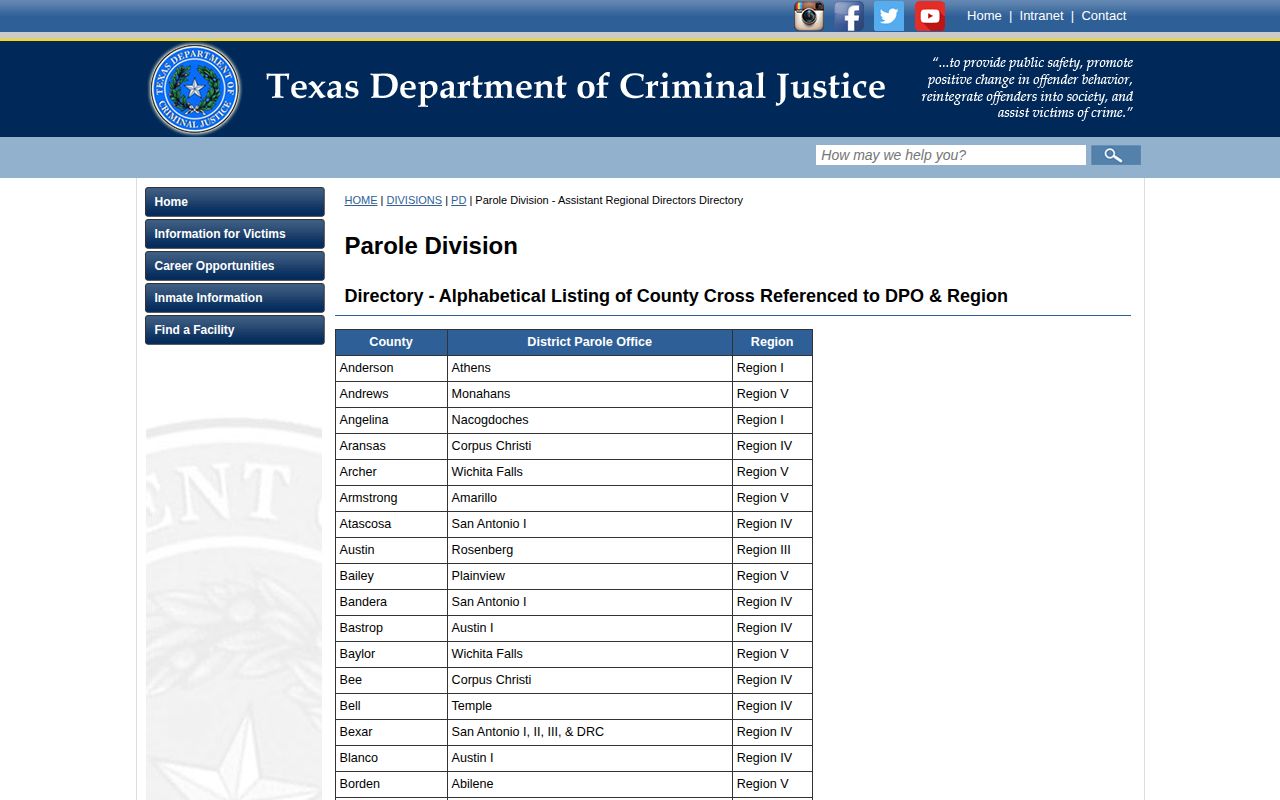
The official TDCJ county directory shows the Swisher-to-Plainview mapping. The screenshot below preserves that routing context, while the live directory should control if assignments change.
When calling, have the TDCJ number and full name ready. Staff may limit information based on identity, confidentiality, and the nature of the request.
Swisher County Probation Record Route
A probation search follows the court file. Swisher County has one combined County and District Clerk, creating a practical doorway for misdemeanor and felony case records. The clerk's iDocket instructions cover criminal indexes and case information beginning January 1, 1992, and the office supplies a judicial-record request form.
Judicial records are not handled as sheriff administrative records under the Texas Public Information Act. Ask for the cause number, judgment, order placing the person on community supervision, modifications, revocation documents, and any discharge order. Inspection is available without charge during office hours, while copies and certifications are priced by the clerk. The office is at 119 South Maxwell in Tulia and lists 806-995-3294 and 806-995-4396. Its published hours are Monday through Thursday, 8 a.m. to 5 p.m., and Friday, 8 a.m. to 3 p.m.
The Swisher clerk record-request page is the official starting point. A docket entry can show that an order exists, but the signed document gives the reliable terms and dates.
Swisher County Supervision Conditions
Conditions vary by the order and the person's case. State parole records may refer to reporting, approved residence, travel limits, programs, monitoring, or other special conditions. A probation judgment can impose a different set of requirements. General descriptions are not a substitute for the individual's written conditions.
A violation allegation does not itself prove a final revocation. Someone already on parole can receive an administrative revocation hearing, which differs from the ordinary parole file review used before release. The outcome may continue supervision, impose sanctions or placement, or return the person to custody. For probation, the court resolves a motion to revoke or adjudicate, and the docket should be paired with the signed ruling.
Swisher County Pre-Release Programming
The Thomas R. Mechler Unit near Tulia lists CHANGES/Pre-Release among its TDCJ programs. That local program helps explain preparation before a possible state release, but participation is not evidence that a person completed the course, received parole approval, or left custody.
Mechler is also classified for transient custody. A person can leave the unit through an internal TDCJ transfer and remain incarcerated. Check the statewide offender record for a new unit and an actual release type. The Thomas R. Mechler Unit page explains that facility-level distinction, while Projected Release covers dates that may still change before departure.
Confirm Swisher County Supervision Discharge
Supervision ends through an authorized discharge, expiration, court action, or another case-specific event. A projected end date is not the same as a completed discharge. For TDCJ cases, request the release or discharge status and relevant dates. For probation, obtain the court's discharge order or final docketed action.
Texas Government Code Chapter 508 governs much of the parole framework, including eligibility and mandatory-supervision exclusions. Those statutes do not turn eligibility into an entitlement to release. Likewise, a parole approval can remain subject to program completion, an accepted release plan, detainer resolution, and a final records audit.
The Board's official review description explains the file-review process. Panel members vote individually; ordinary parole consideration does not have a public hearing calendar. A denial may set another review date, and an approval code should be read using the current official definition. To establish that supervision actually ended, use the final agency record rather than the earlier vote or projected date. The Swisher County released-inmate search guide provides the parallel jail, court, and TDCJ confirmation paths.
A jail release record and a supervision discharge record mark different events. The first shows when Swisher County physical custody ended. The second shows when parole, mandatory supervision, or court-ordered community supervision ended. If dates conflict, ask each custodian for the record it created and compare identifiers, cause numbers, and the named event. A later arrest or hold belongs to a separate custody episode and should not be merged into the earlier discharge.
For state history, a formal TDCJ public-information request can seek release type, supervision dates, discharge date, supervising office, warrant data, and the relevant incarceration episode. For local probation, the signed court order is the central record. Narrow requests reduce name confusion and help the office locate existing documents without being asked to create a narrative.
Public Record Search
Sponsored Results